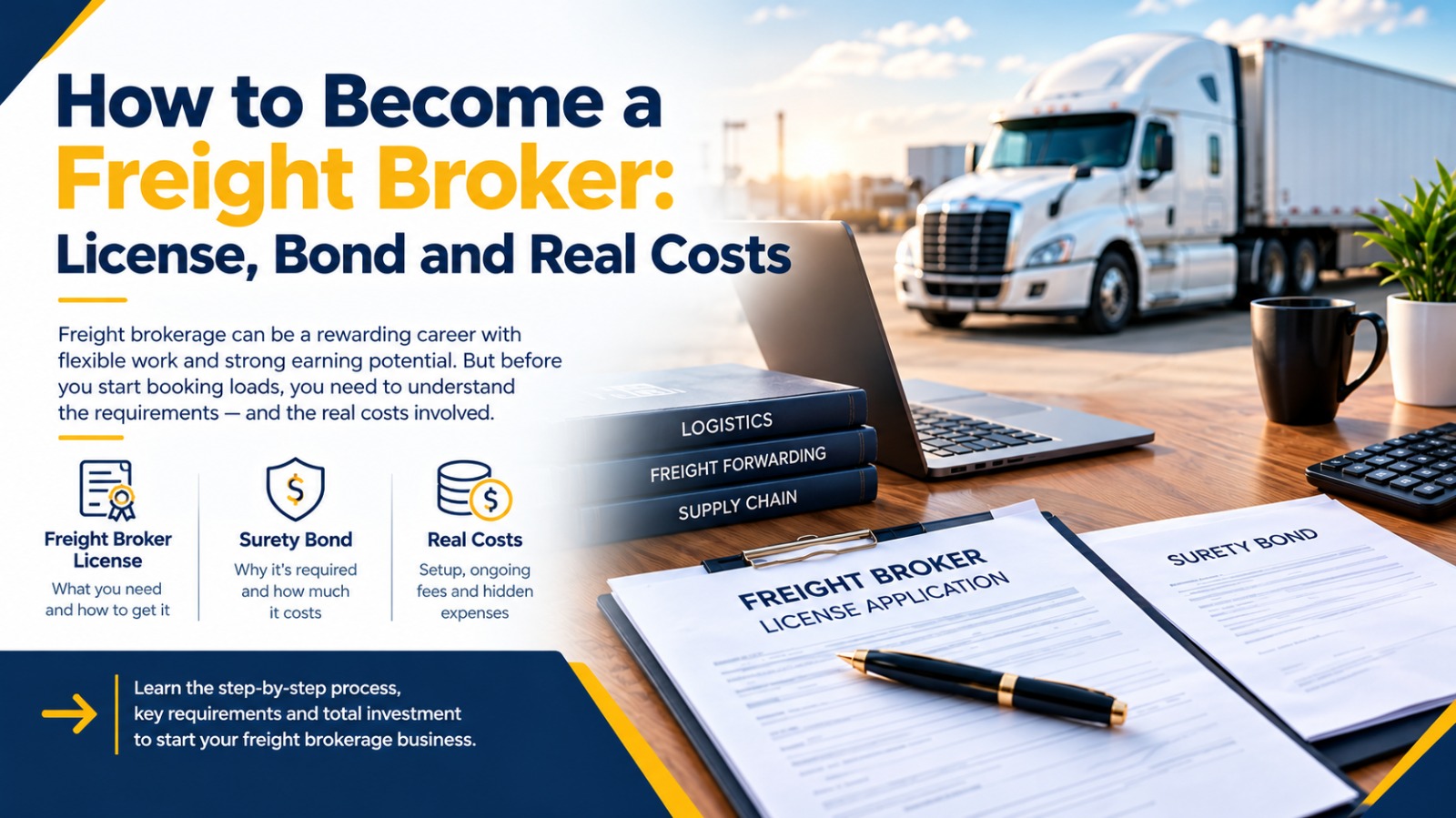
If you want to know how to become a freight broker in the US, here's the short answer. You register for broker authority with the FMCSA, file $75,000 in financial security, designate process agents, and pay a $300 application fee. Then you set up the business behind it: an entity, insurance, contracts, and a way to find shippers and check carriers.
The paperwork is the easy part. Most new brokers don't struggle to get licensed. They struggle to find their first shippers, price loads without losing money, and avoid fraudulent carriers. This guide covers both sides: the licensing steps and costs, and the business skills that decide whether the license ever pays for itself.
We are not a freight broker, and we don't hold broker authority. This is general information based on FMCSA's published requirements. Rules change, so confirm current requirements with the FMCSA before you file anything.
What a Freight Broker Does and How They Get Paid
A freight broker, sometimes called a truck broker or load broker, connects shippers that have freight with motor carriers that have trucks. The broker doesn't own the trucks or the freight. They agree on a rate with the shipper, find a carrier to move the load, agree a lower rate with that carrier, and keep the difference as their margin.
That margin is the whole business. It has to cover your time, software, load board fees, insurance, the cost of your bond, and the risk of a shipper paying late while you still owe the carrier. A broker who wins freight but prices it badly can stay busy and still lose money.
A day in the job usually includes finding and following up with shippers, quoting rates, posting loads, vetting carriers, sending rate confirmations, tracking loads in transit, solving problems when a truck breaks down or a delivery is late, and chasing payments.
Freight Broker vs Dispatcher: Know Which Job You Want
People often confuse these two roles, and the difference matters legally. A freight broker works between the shipper and the carrier, signs contracts with both, and needs FMCSA broker authority plus the $75,000 financial security. A dispatcher works for the carrier. They find loads, negotiate with brokers, and handle paperwork on the carrier's behalf, usually for a percentage or a flat fee.
If you only want to help truck owners find loads, dispatching is a lighter starting point, and our truck dispatcher training guide explains how long it takes to learn. Be careful at the boundary, though. If you start arranging freight for shippers and taking payment to do it, you are acting as a broker, and that requires broker authority.
Two Ways In: Freight Agent or Your Own Authority
There are two realistic answers to how to become a freight broker, and choosing the right one first will save you money.
Starting as a Freight Agent
A freight agent works under an existing broker's authority. The broker provides the license, the bond, the software, and often the carrier setup and billing. The agent brings shippers and handles loads, and the two split the margin on each load. Splits vary widely between brokerages, so read the agreement carefully, especially any non-compete clause. Some brokerages also offer freight broker agent training for new agents, so ask what support you'll get before you sign.
This is the most common answer to how to become a freight broker with no experience. You learn on real freight without paying for your own bond and authority, and you find out whether you can sell before you spend money on a company.
Getting Your Own Broker Authority
With your own authority, you keep the whole margin, control your customers, and build a business you own. You also carry every cost and every risk: the financial security, insurance, software, cash flow, and liability when something goes wrong. Most people who succeed with their own authority either worked in freight first or already have shippers who are willing to give them loads.
How to Become a Freight Broker, Step by Step
If you've decided to get your own authority, these are the steps in the order most people follow.
Step 1: Learn the Business Before You Spend on It
There is no federal licensing exam, and no training is legally required. That doesn't mean you should skip it. Pricing, carrier vetting, contracts, and cash flow are where new brokers lose money, and it's far cheaper to learn them before you pay for a bond. You can learn through community college classes, dedicated broker schools, or self-paced online programs. Our freight broker training course covers licensing, pricing and margin, carrier vetting and fraud prevention, contracts, and cash flow across 8 lessons, with a workbook and a scenario-based exam. Whatever program you choose, look for one that teaches real numbers and real risks, not just how to fill in forms.
Step 2: Form Your Business Entity
Most brokers register an LLC or a corporation rather than operating as a sole proprietor, because it separates business liability from personal assets. Get an EIN from the IRS, open a business bank account, and keep business and personal money apart from day one. An accountant can tell you which structure fits your situation.
Step 3: Apply for Broker Authority With the FMCSA
You apply for property broker authority online with the FMCSA and pay a $300 application fee, which isn't refundable. FMCSA's broker registration page describes this as the OP-1 application. The agency is moving registration from its older Unified Registration System (URS) to a new system called Motus, which adds identity and business verification for new applicants, so use whichever system the FMCSA website currently directs you to. Once your application is processed, you receive your authority number, currently an MC number, although FMCSA has said it plans to phase MC numbers out in a later update. Your authority only becomes active after your financial security and process agent filings are in place.
Step 4: File the $75,000 Bond or Trust Fund
This step covers the freight broker bond requirements. Every property broker needs $75,000 in financial security, filed as either a surety bond (form BMC-84) or a trust fund agreement (form BMC-85). With a bond, you pay a yearly premium to a surety company instead of putting up $75,000 yourself. Your premium depends largely on your credit and finances, so get several quotes. With a trust fund, the full amount is held for you, and from January 16, 2026, trust fund assets are limited to cash, irrevocable letters of credit from a federally insured institution, and Treasury bonds.
The rules around this money became stricter on January 16, 2026. If your security falls below $75,000 because of a claim or drawdown and isn't restored within seven business days, the FMCSA can suspend your authority. In plain terms, paying carriers on time is no longer just good practice. Your license depends on it.
Step 5: Designate Process Agents With a BOC-3
A BOC-3 names a process agent in each state who can receive legal papers on your behalf. Most brokers pay a blanket process agent company to file it for all states at once. The FMCSA allows brokers to act as their own process agent in the state where they write contracts, but a blanket filing is the usual choice.
Step 6: Register for UCR and Get Insurance
Brokers must also register each year with the Unified Carrier Registration (UCR) program. Federal rules only require the $75,000 financial security, but that isn't the end of freight broker insurance requirements in practice. Many shippers expect contingent cargo coverage, general liability, and sometimes contingent auto liability before they'll give you freight. Speak to an insurance agent who works with transportation businesses.
Step 7: Build Your Systems and Book Your First Load
Before your first load, set up a transportation management system or at least a reliable spreadsheet, a load board subscription, a broker-carrier agreement, a shipper agreement, and a carrier vetting process. Check every carrier's authority, insurance, and safety record before you tender a load. Your rate confirmations should state the rate, pickup and delivery details, accessorial charges, and payment terms clearly, because unclear paperwork is where most disputes start. Then start contacting shippers. Your first customers usually come from direct outreach and personal networks, not from waiting for leads.
Freight Broker License Cost: What You'll Really Pay
The freight broker license cost is lower than most people expect, but the total cost of starting is higher. Here's how it breaks down:
- FMCSA application fee: $300, non-refundable.
- Financial security: a yearly surety bond premium, or $75,000 held in a trust fund.
- BOC-3 filing: a one-time fee to a process agent company.
- UCR registration: a yearly fee.
- Business setup: entity formation, registered agent, and bank account.
- Insurance: contingent cargo and general liability, priced by your insurer.
- Tools: load board, TMS or CRM, phone system, and carrier vetting service.
- Working capital: money to pay carriers before shippers pay you.
Working capital is the cost new brokers most often forget. Many carriers expect quick payment, while shippers often pay in 30 days or more. Without cash or a factoring arrangement to cover that gap, a growing book of freight can run you out of money. Get real quotes for each item before you file, because your credit, state, and setup will change the numbers.
How Long Does It Take to Become a Freight Broker?
FMCSA's broker registration page says processing takes approximately four to six weeks. Its newer Motus system adds identity and business verification, with at least eight business days for the initial review and more if an application is flagged for extra checks. Your authority only becomes active once your financial security and BOC-3 are on file, so delays with either filing can stretch the timeline.
Learning the business takes longer than the paperwork. Most people need several months of active selling before they have steady shippers. If you start as a freight agent, you can begin learning on live freight while you decide whether to get your own authority.
How Much Do Freight Brokers Make?
There's no honest single number for a freight broker salary. Salary sites mix together employees at large brokerages, commission-based agents, and owners of small brokerages, so their averages can hide very different realities. An employee earns a salary plus commission. An agent earns a share of the margin on their own loads. An owner earns what is left after carrier payments, staff, software, insurance, and bad debt.
What drives income is the number of loads you move, the margin on each one, and how well you avoid losses from late payments and fraud. In your first months, expect to spend more time finding shippers than moving freight. Anyone who promises a guaranteed income from brokering is selling something.
Is Freight Brokering Right for You?
Freight brokering suits people who are comfortable selling, can handle problems under pressure, and are disciplined with money and paperwork. It suits you less if you dislike cold outreach, don't have savings to cover slow months, or want predictable hours. Trucks break down at night, and loads go wrong on weekends.
If you're still deciding how to become a freight broker, start with proper training, then work as an agent or inside a brokerage before you commit to your own authority. That path costs less and gives you a real answer to whether this career fits you.
Frequently Asked Questions
Do you need a license to be a freight broker?
Yes. To arrange freight for compensation as a broker, you need property broker authority from the FMCSA and $75,000 in financial security. Freight agents can work under an existing broker's authority instead of holding their own.
How much does it cost to become a freight broker?
The FMCSA application fee is $300. Beyond that, you'll pay for financial security, a BOC-3 filing, UCR registration, insurance, business setup, and software, plus working capital to pay carriers before shippers pay you. Total costs depend on your credit, state, and setup.
Can you become a freight broker with no experience?
Yes, but most people without experience start as freight agents or work at a brokerage first. That lets you learn pricing, carrier vetting, and customer service on real freight before you pay for your own authority and bond.
Is there a freight broker license test?
No. There is no federal licensing exam for brokers. Training is optional, but it helps you avoid expensive mistakes with pricing, contracts, and carrier fraud.
What is the difference between a freight broker and a freight agent?
A broker holds their own FMCSA authority and financial security and is responsible for the loads they arrange. A freight agent works under a broker's authority and shares the margin on loads they bring in.
Is freight broker a good career?
It can be for people who like sales, problem-solving, and running numbers. Income depends on your loads and margins, not on the license itself, and the first months are usually the hardest. Learning the business first lowers the risk.
Frequently asked questions
Do you need a license to be a freight broker?
Yes. To arrange freight for compensation as a broker, you need property broker authority from the FMCSA and $75,000 in financial security. Freight agents can work under an existing broker's authority instead of holding their own.
How much does it cost to become a freight broker?
The FMCSA application fee is $300. Beyond that, you'll pay for financial security, a BOC-3 filing, UCR registration, insurance, business setup, and software, plus working capital to pay carriers before shippers pay you. Total costs depend on your credit, state, and setup.
Can you become a freight broker with no experience?
Yes, but most people without experience start as freight agents or work at a brokerage first. That lets you learn pricing, carrier vetting, and customer service on real freight before you pay for your own authority and bond.
Is there a freight broker license test?
No. There is no federal licensing exam for brokers. Training is optional, but it helps you avoid expensive mistakes with pricing, contracts, and carrier fraud.
What is the difference between a freight broker and a freight agent?
A broker holds their own FMCSA authority and financial security and is responsible for the loads they arrange. A freight agent works under a broker's authority and shares the margin on loads they bring in.
Is a freight broker a good career?
It can be for people who like sales, problem-solving, and running numbers. Income depends on your loads and margins, not on the license itself, and the first months are usually the hardest. Learning the business first lowers the risk.
Want this handled for you?
We dispatch owner-operators from 6% of gross or $300 a week, and file new authority for a flat $649 plus government fees at cost. No contracts either way.
Keep reading
Power Only Loads: Where to Find Them, What They Pay, and What to Check Before You Hook
Where to find power-only loads, how to check if a load pays using your own cost per mile, and what a trailer i
GuideHow Long Is Truck Dispatcher Training? (Free 9-Hour Course vs Paid Programs)
How long is truck dispatcher training? Compare free vs paid courses and see real timelines before you spend a
RatesSemi-Truck Valuation Tool: Know Your Truck's Real Worth (2026)
Wondering what your semi-truck is actually worth? Our free AI valuation tool gives you an instant market range