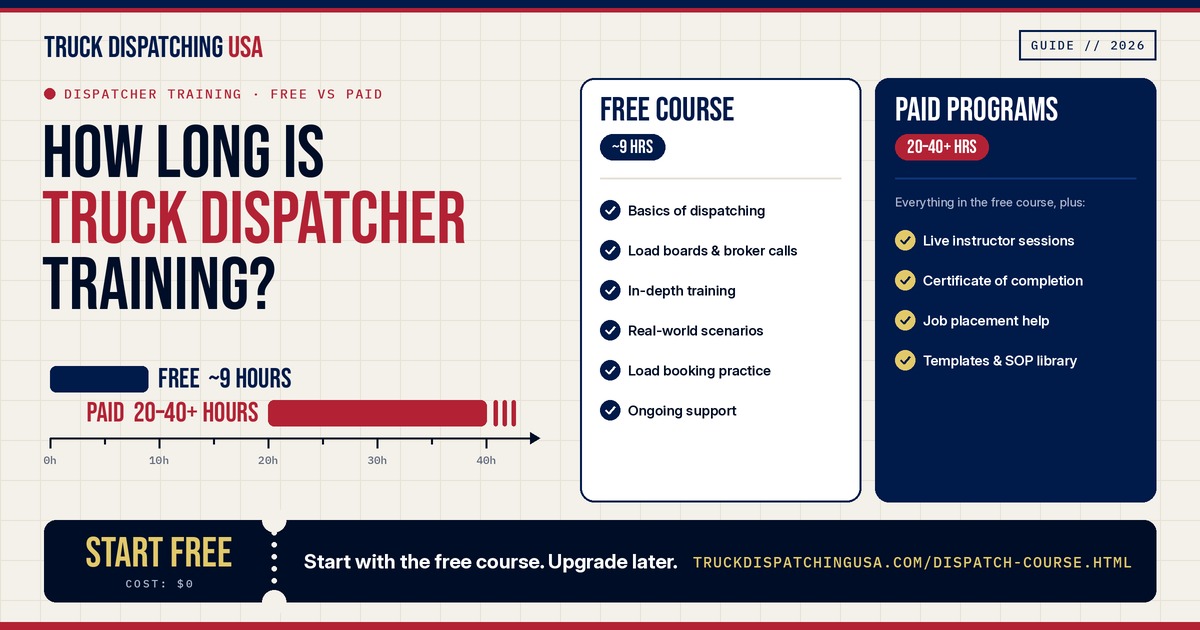
If you've searched "how long is truck dispatcher training," you've probably noticed the answer changes depending on which site you land on - two days, two weeks, or three months, with price tags anywhere from $360 to $995. The honest answer is that it depends entirely on which path you pick: a paid bootcamp, a classroom program, or a free self-paced course like the one Truck Dispatching USA for people who want to learn the job without paying for it first.
The Short Answer
Truck dispatcher training can take as little as a few hours or as long as three months, depending on the format. A free, self-paced online course can be finished in under 9 hours of actual study time. A paid classroom or live-instructor program usually runs two days to three weeks. On-the-job training at a brokerage or carrier can stretch from a few days to several months, depending on how much supervision you get.
There is no single government-mandated training length for truck dispatchers, because dispatching itself isn't a licensed profession. That's part of why the duration varies so much from one provider's answer to the next.
What Paid Training Programs Actually Say About Duration
Looking at what's currently published by dispatcher training providers, three different numbers show up depending on the format:
Live, instructor-led bootcamps run the shortest - one provider's in-person or live-online course is advertised at two days, priced at $995, and includes hands-on practice with the company's own dispatch software plus a certificate.
Self-paced paid courses in the $360 to $775 range are typically built around two to three weeks of study, covering dispatch software, rate negotiation, regulatory basics, and standard load-board workflows. Some of these providers note that most graduates land their first paycheck within 60 to 90 days of finishing, not immediately after the course ends.
Classroom-based or more academic programs run the longest - anywhere from four weeks to three months - and often fold in general business and administrative content alongside the dispatching material, which is part of why they take longer to complete.
Why the Time Needed Varies So Much
A few honest factors explain the gap between a two-day bootcamp and a three-month classroom program:
Format matters more than content. A self-paced course lets you move as fast as your schedule allows, while a cohort-based or classroom program moves at the pace of the slowest student and has to wait for scheduled sessions.
Your starting point matters. Former CDL drivers and people who've worked in carrier accounting or logistics admin already understand freight flow, paperwork, and equipment types, so they move through training faster than someone starting with zero trucking background.
What you're training for matters. Training to dispatch as an employee for a carrier is a different, shorter track than training to run your own independent dispatch business, since the business side (contracts, invoicing, finding your first clients) adds real time on top of the core dispatching skills.
A Free, 9-Hour Path That Skips the Price Tag Entirely
Instead of charging $360 to $995 before you even know if dispatching is the right fit, Truck Dispatching USA's free dispatcher course covers the same ground in roughly 9 hours of self-paced lessons, split into 13 lessons across 5 modules:
Foundations covers what the job actually is, how freight moves, and the different equipment types you'll be dispatching.
Rules of the road covers authority, insurance, and the legal line between a dispatcher and a broker - one of the most commonly misunderstood parts of the job.
Finding and pricing loads covers load boards, rate math, negotiation, and how to plan a week of freight instead of chasing one load at a time.
Running the freight covers paperwork, getting paid, managing an active trip, and how to spot freight fraud and vet brokers before you work with them.
Building your own business covers what it actually takes to dispatch for yourself rather than for a carrier.
Each lesson includes an advanced section, a case study, a checklist, and a quiz, and a 25-question final exam leads to a certificate with a QR code that can be verified online. The first 100 certificates are free; after that, a certificate is a one-time paid add-on. You sign in with just your email - no password - and your progress saves across devices, so you can genuinely finish it in short sessions over a few days instead of blocking out a weekend.
Training Completion Isn't the Same as Being Ready to Earn
Here's the part most course pages gloss over: finishing training, whether it takes two days or two months, isn't the same as being a working dispatcher with income. Industry data on paid courses suggests most graduates still need 60 to 90 days after training to land their first real paycheck, because that period covers finding carriers or clients, building trust with brokers, and learning the rhythm of daily dispatch work that no course can fully simulate.
That's worth knowing upfront so you don't treat a 9-hour course, or even a $995 two-day bootcamp, as a guarantee of income on day one. What training actually buys you is a faster, cheaper way to learn the fundamentals so you're not learning them for the first time on a live load with real money on the line.
Frequently asked questions
How long is truck dispatcher training?
It ranges from about 9 hours for a free, self-paced course to two days for an intensive paid bootcamp, and up to three months for a classroom-style program. There's no fixed legal minimum because dispatching isn't a licensed profession, so the number depends entirely on which format and provider you choose.
Can I become a truck dispatcher without paying for a course?
Yes. Free courses exist that cover the same core material — freight basics, authority and insurance rules, load pricing, paperwork, and running a dispatch business — without the $360 to $995 price tag charged by paid bootcamps. The tradeoff is usually that free courses are self-paced rather than live, instructor-led, so you need the discipline to finish on your own.
Do truck dispatchers need a license or certification?
No government license is required to work as a dispatcher, whether you're employed by a carrier or running your own dispatch business. A certificate from a training course is a voluntary credential that can help when you're applying for work or pitching new clients, but it isn't a legal requirement to operate.
Once training is done, how do I actually find carriers or clients to dispatch for?
This is usually the hardest part that training alone doesn't solve, since most courses end at the knowledge stage and leave the client-finding stage to you. Platforms like the Truck Dispatching USA marketplace exist specifically to connect dispatchers and carriers directly, without the markup or middlemen that make this step harder for people just starting out.
Want this handled for you?
We dispatch owner-operators from 6% of gross or $300 a week, and file new authority for a flat $649 plus government fees at cost. No contracts either way.
Keep reading
Power Only Loads: Where to Find Them, What They Pay, and What to Check Before You Hook
Where to find power-only loads, how to check if a load pays using your own cost per mile, and what a trailer i
RatesSemi-Truck Valuation Tool: Know Your Truck's Real Worth (2026)
Wondering what your semi-truck is actually worth? Our free AI valuation tool gives you an instant market range
GuideShould You Drive for a Fleet with Dispatch Support? Here's What Changes
Most driver job listings look the same on paper - pay, home time, equipment. What they don't explain is how mu