If you're searching for power-only loads, you've probably noticed that most guides explain the concept and stop there. They rarely tell you where the freight is posted, how to judge whether a load pays, or what you become responsible for once you hook a trailer that isn't yours. This guide covers all three.
A power-only load is freight moved in a trailer you don't own. The shipper, broker, or carrier program supplies the trailer, and you supply the tractor and the driver. That simplicity is why power-only trucking appeals to owner-operators who want to skip trailer payments. The catch is that the risks sit in the paperwork rather than on the road, and that's where we'll spend most of this article.
What Power Only Loads Are and How They Work
In plain terms, power-only loads are tractor-only moves. A trailer is waiting at a shipper's yard, a warehouse, or a drop lot. You arrive with your tractor, hook it, pull it to the delivery point, and either drop it or wait while it's unloaded.
Most work follows one of two patterns. In drop-and-hook, you swap trailers without waiting on a dock, so you lose less unpaid time. In live loads, you stay with the trailer during loading or unloading, which makes detention terms important.
The real difference from running your own van, reefer, or flatbed is what you're selling: availability and reliability, not equipment. Shippers and brokers use tractor-only carriers to cover surges and keep trailer pools moving without buying more tractors.
Where to Find Power Only Loads
There's no single marketplace for this work, so most owner-operators combine three sources.
Power Only Load Boards
Major boards such as DAT and Truckstop let you filter by equipment type, and power-only is usually one of the options. Set that filter, then narrow by pickup radius and trailer type, because a tractor-only move can involve anything from a dry van to a reefer. Before paying for a second subscription, read our framework for choosing a load board. Most carriers need only one board, and the features worth paying for are broker credit data and freight density in your own lanes.
Shipper and Carrier Programs
Amazon Relay Power Only is one of the larger programs, and many of the power-only trucking companies you'll find in search results, including J.B. Hunt and Schneider, run carrier programs that use third-party tractors. Each has its own onboarding, insurance requirements, and payment terms, so read the current terms at the source instead of trusting a forum summary.
Brokers and Direct Shippers
After a few clean runs, brokers and shippers often call you directly, and that's where steadier lanes tend to come from. Keep a short list of reliable contacts.
What Power Only Loads Pay and How to Check a Load
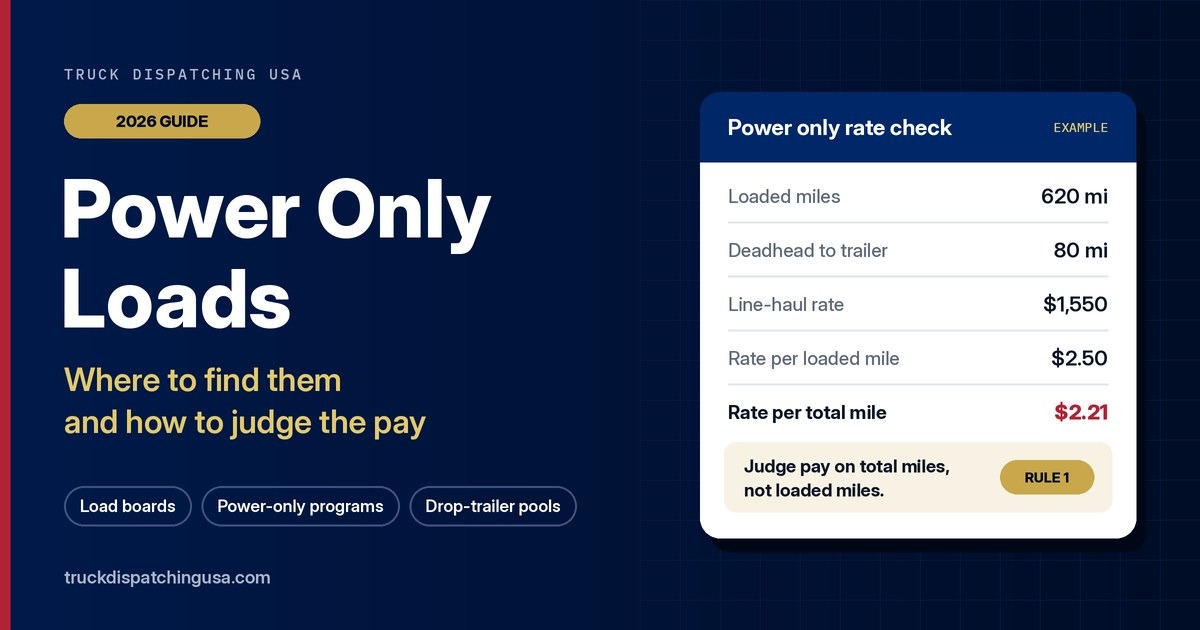
Power-only trucking rates vary with lane, distance, trailer type, season, and how urgently the freight needs to move. Short runs usually pay more per mile than long hauls, and published guides quote wide ranges for power-only rates per mile while calling them directional. Treat any figure you read online as context, not a promise. The number that matters is your own cost per mile. Enter your fixed costs, fuel, maintenance, and deadhead into our cost per mile calculator to find your rate floor, then compare every load against it.
Here's a worked example using invented numbers, not market rates. A 400-mile load at $2.20 per mile pays $880. You run 50 miles empty to reach it, so the truck covers 450 miles. At 6 miles per gallon and $4.00 a gallon, fuel costs $300. Tolls, factoring, and any dispatch fee take another $75 in this example. That leaves $505 before insurance, truck payment, maintenance, and your own pay, or about $1.12 for every mile the truck moved. Whether that works depends entirely on your costs, which is why a headline rate tells you very little on its own.
Trailer Interchange Agreement and Insurance Explained
Before you hook someone else's trailer, you'll usually sign a trailer interchange agreement. It makes you responsible for the trailer's condition and for damage while it's in your possession, and it often sets inspection duties and late-return charges.
Trailer interchange insurance is the coverage that pays for physical damage to a trailer you don't own. Your tractor policy and cargo policy don't automatically cover it. Many programs ask for limits that commonly start around $20,000 for a dry van, with higher figures for reefers, and published guides put the annual cost in the range of a few hundred to a couple of thousand dollars for small fleets. Your price depends on your insurer, your record, and the equipment you pull, so get a quote before you accept your first load.
This is general information, not insurance advice. Confirm required limits with the program and a licensed insurance agent.
Before You Hook: A Six-Step Checklist
Run through these steps on every tractor-only load:
Confirm your authority and insurance are active and meet the program's requirements.
Read the rate confirmation for the trailer number, pickup and drop locations, detention terms, and any per-diem or late-return charge.
Inspect the trailer before you leave, including tires, lights, doors, landing gear, and air connections, and take dated photos of any damage.
Confirm drop instructions, gate codes, and who to call if the trailer isn't ready.
Check payment timing before you accept the load, not after you deliver it.
Avoid sending all your freight through one program, so a single lane or contact drying up doesn't stop your income.
Is Power Only a Good Fit for an Owner-Operator?
A power-only owner-operator can start with one truck, and many do, because there's no trailer to buy. The model suits drivers who want flexibility, read contracts carefully, and keep deadhead low. It suits you less if you depend on one customer, can't absorb unpaid waiting, or haven't priced your real costs.
Finding steady lanes is the hard part. If you'd rather not source the freight yourself, our power-only dispatch service books tractor-only freight for owner-operators and small fleets
Frequently asked questions
What is power-only trucking?
Power-only trucking is hauling freight in a trailer supplied by the shipper, broker, or carrier program, while you provide the tractor and driver. Power-only loads are individual moves: you hook the trailer, pull it to the destination, and then drop it or wait for unloading.
Do power-only loads pay less than regular loads?
Per loaded mile, they often do, because you aren't supplying the trailer. The trade-off is no trailer payment or trailer maintenance, and less dock waiting on drop-and-hook freight. Compare each load to your own cost per mile instead of a market average.
Who pays if a power-only trailer is damaged?
It depends on the trailer interchange agreement you signed, but you are commonly responsible for damage while the trailer is in your possession. Trailer interchange insurance exists for this, so confirm the required limits and photograph the trailer at pickup.
Want this handled for you?
We dispatch owner-operators from 6% of gross or $300 a week, and file new authority for a flat $649 plus government fees at cost. No contracts either way.
Keep reading
How Long Is Truck Dispatcher Training? (Free 9-Hour Course vs Paid Programs)
How long is truck dispatcher training? Compare free vs paid courses and see real timelines before you spend a
RatesSemi-Truck Valuation Tool: Know Your Truck's Real Worth (2026)
Wondering what your semi-truck is actually worth? Our free AI valuation tool gives you an instant market range
GuideShould You Drive for a Fleet with Dispatch Support? Here's What Changes
Most driver job listings look the same on paper - pay, home time, equipment. What they don't explain is how mu