Carrier onboarding is the step that stands between a truck and a load. Before a broker tenders freight, someone has to confirm the carrier is legal, insured, and who they say they are. That check happens through a carrier packet, and if you're a new broker, a dispatcher, or an owner-operator who just got one, it can look like a pile of random forms.
It isn't random. Every document answers a question about risk, payment, or legal responsibility. Here's what each one is for, the full process step by step, and the mistakes that hold up loads.
What Is Carrier Onboarding?
Carrier onboarding is the process a freight broker uses to verify and approve a motor carrier before giving it loads. The broker collects the carrier's operating authority, insurance, tax and payment details, and a signed agreement, then checks them against FMCSA records to confirm the carrier is legal, insured, and genuine.
Once approved, the carrier is "set up" with that broker and can be booked on loads. Every broker runs its own onboarding, so a carrier hauling for 20 brokers goes through 20 setups.
What Is a Carrier Packet?
A carrier packet is the set of documents a carrier sends to a broker to get approved for loads. In trucking, it's the paperwork side of onboarding. Brokers keep it on file in case of a claim, an audit, or a payment dispute.
You'll also hear it called a carrier setup packet or a carrier onboarding packet. The terms mean the same thing. The only difference is direction. Brokers usually say "carrier setup packet" for the blank forms they send out, while carriers say "carrier packet" for the ready-made bundle they send to every new broker.
What Documents Are in a Carrier Packet?
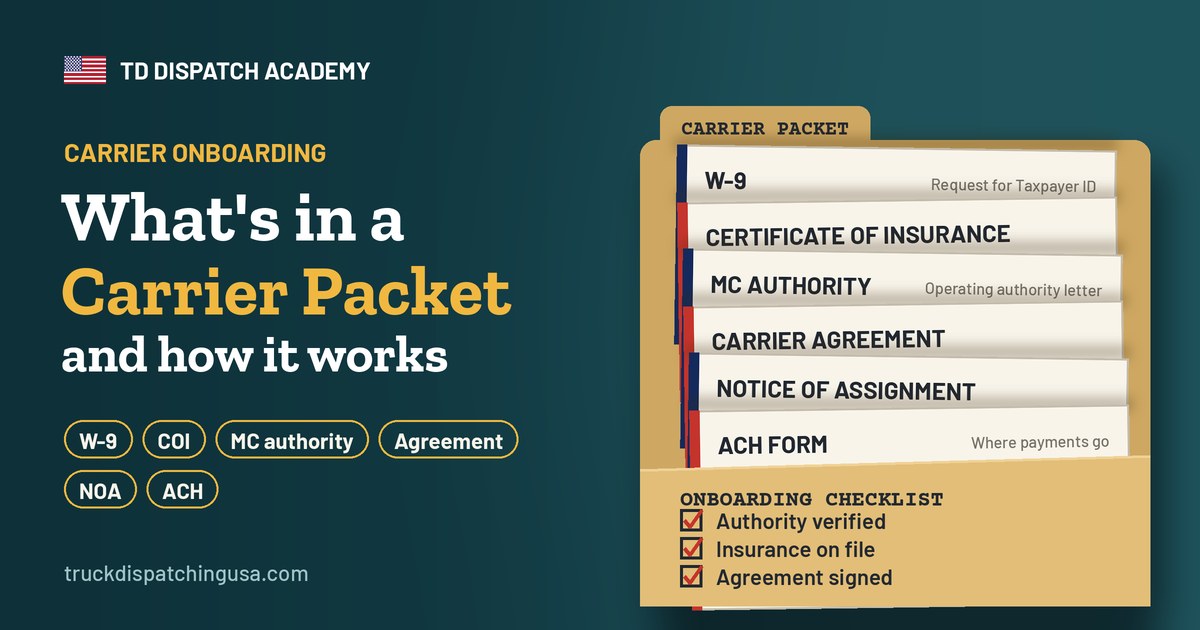
A typical carrier packet for a broker includes six core documents. Some brokers add extras, such as equipment lists, but these six show up almost everywhere.
W-9 Form
The W-9 is an IRS form that gives the carrier's legal business name, business type, and taxpayer identification number, either an EIN or an SSN. Brokers ask for it because they pay the carrier and need correct tax information for year-end reporting.
The common mistake is a name mismatch. The legal name on the W-9 should match the name on the carrier's FMCSA registration and bank account. If the W-9 says "Mike's Trucking" but the authority is registered to "MJ Transport LLC," the setup stalls.
Certificate of Insurance (COI)
A Certificate of Insurance is a one-page summary from the carrier's insurance agent that shows its coverage types, limits, policy numbers, and dates. Brokers need it because if a truck crashes or freight is damaged, they need to know the carrier's insurance will respond.
Federal rules require at least $750,000 in auto liability for for-hire carriers hauling general freight in vehicles of 10,001 pounds or more. Many brokers ask for more, commonly $1,000,000 auto liability and $100,000 in cargo coverage, but every broker sets its own limits. The broker is listed as the certificate holder, and the carrier stays the named insured. Common mistakes are expired dates and the wrong certificate holder.
Operating Authority Letter
The operating authority letter is the FMCSA document that shows the carrier's MC number, DOT number, and that it's authorized to haul property for hire. Brokers check it to confirm the carrier can legally take paid loads in interstate commerce.
The letter alone isn't enough. Brokers check the live record on FMCSA's SAFER system, because authority can go inactive after the letter was printed, and a pending authority won't pass. FMCSA is also gradually moving toward the USDOT number as the main identifier, so expect both numbers to be checked.
Signed Broker-Carrier Agreement
The broker-carrier agreement is the contract that sets the terms for every load the carrier hauls for that broker. It covers payment terms, liability for cargo claims, insurance requirements, and rules against re-brokering or double brokering.
It controls what happens when something goes wrong, so read payment terms, quick-pay fees, and claim deductions before you sign.
Voided Check or Payment Setup Form
A voided check or bank letter tells the broker where to send payment by ACH. Brokers verify it carefully, because fake banking changes are a common way fraudsters steal carrier payments.
Don't send bank details that don't match the business name, and expect a phone check if you ever change banks.
Notice of Assignment for Factoring Carriers
A notice of assignment, or NOA, is a letter from a factoring company that tells the broker to pay the factor instead of the carrier. If a carrier factors its invoices, the NOA replaces the voided check.
A broker that pays the carrier directly after receiving an NOA can end up paying twice. If you're deciding whether factoring is worth it, our guide on factoring and the real math breaks it down.
The Carrier Onboarding Process, Step by Step
The carrier onboarding process follows the same seven steps at most brokerages, whether done by hand or through software.
- Collect the carrier's basic information. Get the company name, MC and DOT numbers, contact person, phone, email, equipment type, and the carrier packet documents.
- Verify the MC number on FMCSA SAFER. Look up the carrier's SAFER company snapshot and confirm the legal name, address, and an operating status of authorized for property, with no out-of-service order.
- Check the insurance certificate. Confirm the coverage types, limits, and dates on the COI. Then check FMCSA's Licensing and Insurance records to confirm the insurance is actually on file with the government, not just on paper.
- Review safety rating and authority status. Check the safety rating (Satisfactory, Conditional, Unsatisfactory, or not rated), inspection history, and how long the authority has been active.
- Get the agreement signed. Send the broker-carrier agreement and get it signed by an authorized person at the carrier.
- Set up payment and check factoring. Verify the bank account or NOA, and record the payment terms the carrier chose.
- Save the file and keep it current. Store every document, record the date of each check, and set reminders for insurance expiration dates.
The step that protects brokers most is identity verification. Fraudsters steal real carriers' MC numbers and send packets with fake contact details, so always contact the carrier using the phone or email on its FMCSA registration.
Once a carrier is approved and booked, the next document is the rate confirmation. For what every line means, read our guide rate confirmations explained.
What a Carrier Packet Template Should Include
A good carrier packet template saves time on both sides. Carriers should build one PDF they can send to any new broker, and brokers should ask only for what they'll actually check.
A complete template includes:
- A company profile sheet with legal name, MC and DOT numbers, address, contact person, phone, email, equipment types, and preferred lanes.
- A current W-9 in the legal business name.
- A current COI, with a note that brokers can request their own certificate from your agent.
- Your FMCSA operating authority letter.
- A voided check or bank letter, or an NOA if you factor.
- A space for the broker-carrier agreement signature.
A free carrier packet template takes minutes to build in any PDF editor, and a filled-in carrier packet example from a broker you already work with is a good model. The key is keeping it current, because an outdated COI or old bank letter creates delays.
Carrier Packet for Owner-Operators: What's Different
A carrier packet for an owner-operator contains the same documents, but you usually assemble it alone, so one wrong detail delays every setup.
Three things matter most. First, make your W-9, FMCSA registration, and bank account all use the same legal name. Second, know how to get certificates from your insurance agent quickly, since brokers often need one the same day. Third, expect extra checks if your authority is new. Many brokers are cautious with new authorities, and our article on MC authority setup explains why new carriers get turned down and how to avoid it.
Onboarding goes both ways. Before you send your banking details to a broker, check that the broker is real and pays on time. Our guide to checking broker credit shows what to look for.
Carrier Setup Online: Manual vs Software
Carrier setup online now handles most onboarding at mid-size and large brokerages. Carriers create one profile on an onboarding platform and share it with each broker.
Platforms such as MyCarrierPackets, Highway, and RMIS pull FMCSA data automatically, store documents, flag insurance changes, and check for identity fraud signals. Carriers fill in their details once instead of 20 times, and brokers get speed and ongoing monitoring.
Manual onboarding still works for small brokers handling a few carriers, but every check is done by hand and expirations are easy to miss.
Carrier Onboarding as a Back-Office Job
Carrier onboarding is a real job, often called carrier setup, carrier compliance, or carrier services. Recent listings show what it pays: one freight brokerage specialist role that includes onboarding carriers lists $22 to $27 per hour, and a full-time carrier compliance specialist role that reviews carrier packets lists $50,000 to $65,000 a year.
Our Back-Office and Career course covers carrier onboarding and compliance admin in a full lesson, alongside invoicing, collections, load paperwork, and driver settlements, with a final exam and a certificate.
The 5 Most Common Carrier Onboarding Mistakes
- Name mismatches. The W-9, FMCSA record, COI, and bank account show different business names.
- Expired or wrong insurance certificates. The COI is out of date or lists the wrong certificate holder.
- Trusting the packet instead of FMCSA. The broker checks the documents but not the live SAFER and insurance records.
- Skipping identity verification. Nobody calls the phone number listed with FMCSA, which is how stolen MC numbers get through.
- No expiration tracking. Insurance lapses after setup, and nobody notices until a claim.
Frequently asked questions
What is carrier onboarding?
Carrier onboarding is the process a freight broker uses to verify and approve a motor carrier before giving it loads. It involves collecting the carrier's authority, insurance, W-9, payment details, and a signed agreement, and checking them against FMCSA records.
What is a carrier packet?
A carrier packet is the set of documents a trucking company sends to a freight broker to get approved for loads. It usually includes a W-9, certificate of insurance, operating authority letter, signed broker-carrier agreement, and a voided check or notice of assignment.
What is the difference between a carrier packet and a carrier setup packet?
A carrier packet and a carrier setup packet are the same set of onboarding documents. Brokers often say "setup packet" for the blank forms they send, while carriers say "carrier packet" for their own ready-made document bundle.
How long does carrier onboarding take?
Carrier onboarding can take anywhere from a few minutes to a few days. Online platforms with complete, matching documents can approve a carrier the same day, while missing documents, name mismatches, or new authorities often add delays.
What insurance do brokers require from carriers?
Most brokers require auto liability and cargo insurance. Federal rules set a $750,000 minimum auto liability for general freight carriers, and many brokers ask for $1,000,000 auto liability and $100,000 cargo, though each broker sets its own limits.
Do I need a new carrier packet for every broker?
You can usually reuse the same carrier packet with every broker. Keep one current version with your W-9, COI, authority letter, and payment details, and fill out each broker's agreement and setup forms separately.
Want this handled for you?
We dispatch owner-operators from 6% of gross or $300 a week, and file new authority for a flat $649 plus government fees at cost. No contracts either way.
Keep reading
What Is a CSA Score? How It’s Calculated and How to Lower It
How CSA scores work in trucking: the seven BASICs, severity and time weights, intervention thresholds, and the
BrokersHow to Become a Freight Broker: License, Bond and Real Costs
Step-by-step guide to becoming a freight broker: FMCSA broker authority, the $75,000 bond or trust, real start
GuidePower Only Loads: Where to Find Them, What They Pay, and What to Check Before You Hook
Where to find power-only loads, how to check if a load pays using your own cost per mile, and what a trailer i