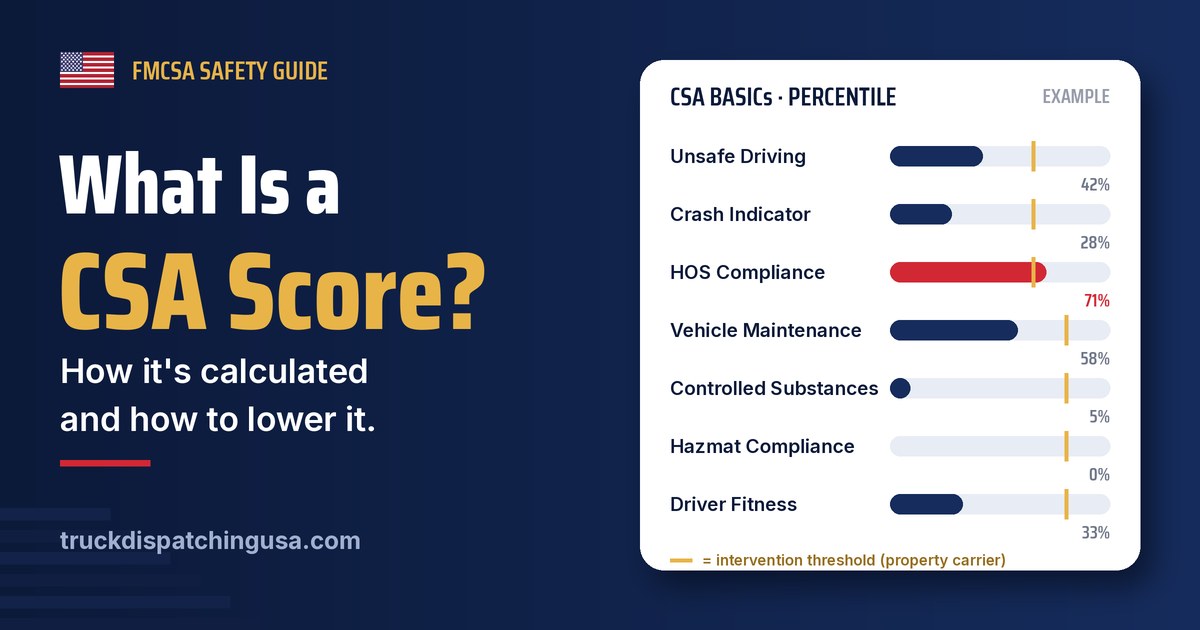
A CSA score is how the FMCSA ranks a motor carrier's safety performance against similar carriers, using roadside inspections, violations, and crashes from the past two years. It isn't one number. It's a set of percentiles from 0 to 100, one for each safety category, and a higher percentile means a worse result. Cross the line in any category, and your company can land on the FMCSA's radar for warning letters, investigations, or audits.
For a small carrier, that matters well beyond the FMCSA. The inspection history behind your scores is often checked by insurers and brokers, and a run of violations can cost you better rates and better freight. This guide explains how the system works today, how the numbers are calculated, and what actually brings them down.
FMCSA approved a revised scoring method in November 2024, but as of November 2026, it has not gone live, and no launch date has been published. Carriers are still measured under the current Safety Measurement System, which is what this guide explains.
What Is a CSA Score?
CSA stands for Compliance, Safety, Accountability, the FMCSA's enforcement program for motor carriers. The scores come from its Safety Measurement System (SMS), which groups safety data into seven categories called BASICs.
The Seven BASICs
- Unsafe Driving: speeding, reckless driving, improper lane changes, phone use and similar violations.
- Crash Indicator: your history of reportable crashes.
- Hours-of-Service (HOS) Compliance: logbook and ELD violations, driving over hours, and false logs.
- Vehicle Maintenance: brakes, lights, tires, defects and other equipment problems found at inspection.
- Controlled Substances/Alcohol: drug and alcohol violations.
- Hazardous Materials (HM) Compliance: placarding, paperwork, and packaging violations for hazmat loads.
- Driver Fitness: licensing, medical certificate, and qualification problems.
Who Can See Your Scores
Since the FAST Act of 2015, FMCSA has removed property carriers' percentiles and alerts from public display. You can see your own percentiles by logging in to the SMS website. The inspection and violation records behind them are another matter, because they can still show up in the reports that brokers, shippers and insurers use to vet carriers. Treat your inspection history as if everyone can see it.
How the Score Is Calculated
The math looks complicated, but it comes down to four parts.
Severity Weight
Each violation is given a severity weight from 1 to 10, depending on how strongly that type of violation is linked to crash risk. A minor paperwork issue scores low. A brake that's out of service scores much higher. Out-of-service violations count more than ones that let you keep driving. The severity weights from a single inspection are capped at 30 per BASIC.
Time Weight
Recent violations count more than old ones:
- Violations from the past 6 months are multiplied by 3.
- Violations from 6 to 12 months ago are multiplied by 2.
- Violations from 12 to 24 months ago are multiplied by 1.
After 24 months, a violation drops out of the SMS calculation entirely.
Your Size and Exposure
Your weighted violations are then compared with how much you operate. For some BASICs, that means your number of power units and miles driven. For others, it means the number of inspections you've had. A fleet of 50 trucks with five violations is in a very different position from a single truck with five violations.
The Percentile Ranking
Finally, your result is ranked against carriers with a similar amount of data, which produces a percentile from 0 to 100. A percentile of 70 means your measure is worse than 70 percent of comparable carriers. If you don't have enough inspections or violations in a BASIC, you won't receive a percentile for it at all.
What Counts as a Bad Score?
A score becomes a problem when it reaches FMCSA's intervention threshold for that BASIC. For general property carriers, the current thresholds are:
- 65 percent: Unsafe Driving, Crash Indicator, and HOS Compliance.
- 80 percent: Vehicle Maintenance, Controlled Substances/Alcohol, Driver Fitness, and HM Compliance.
Passenger carriers and hazmat carriers face lower thresholds. Above the threshold, FMCSA may send a warning letter, prioritize your trucks for roadside inspection, or open an investigation. In practice, a "good" CSA score means staying well below every threshold, and a carrier with few or no violations may have no percentile at all.
Why It Matters to Your Business
FMCSA intervention is the official consequence, but the business effects are often felt first. Insurance underwriters look at inspection and violation history when they quote premiums. Many brokers and shippers screen carriers through monitoring services before giving them freight, and a pattern of out-of-service violations can quietly cost you loads. For a new authority, a few bad inspections early on weigh heavily, because there are so few clean ones to balance them.
Understanding how roadside inspections, CSA scores, audits, and accidents connect is one of the most useful things a small carrier can learn, and it's a full lesson in our safety and compliance course, alongside DQ files, drug and alcohol testing, and hours of service.
How to Lower Your CSA Score
There's no shortcut and no fee that deletes a valid violation. What works is fewer violations going forward and correcting the wrong ones:
- Do real pre-trip inspections. Most Vehicle Maintenance violations are lights, tires and brakes that a thorough pre-trip and an honest DVIR would have caught.
- Run clean logs. Make sure every driver understands hours-of-service limits and the ELD, and review logs regularly instead of waiting for a roadside officer to do it.
- Hire and qualify drivers properly. Complete driver qualification files, current medical certificates and Clearinghouse queries keep the Driver Fitness and Controlled Substances BASICs clean.
- Coach unsafe driving. Speeding and phone violations fall under Unsafe Driving, one of the BASICs with the lower 65 percent threshold, so address them quickly.
- Collect clean inspections. For several BASICs, inspections with no violations increase the number you're measured against, which can bring your measure down over time.
- Challenge errors through DataQs. If a violation was recorded incorrectly, or a crash wasn't preventable, you can request a review through FMCSA's DataQs system. Submit evidence, not just an explanation.
Time also helps. Violations lose weight after 6 and 12 months and drop off after 24 months, so a carrier that stays clean will see its scores improve. If you'd rather have someone keep your files, testing records, and logs in order every month, our DOT compliance service handles that side of the business for small fleets.
At Truck Dispatching USA, we work with owner-operators and small fleets every day, and the pattern is consistent: carriers with clean inspection histories get better freight and fewer problems. Your CSA score is simply the record of that discipline.
Frequently asked questions
What is a good CSA score?
A good score is one that sits well below FMCSA's intervention threshold in every BASIC, which is 65 or 80 percent for general property carriers depending on the category. Lower is always better, and having no percentile because you have very few violations is also a good sign.
Can CSA points be removed?
Valid violations can't be deleted, but incorrect ones can be challenged through FMCSA's DataQs system. Violations also lose weight over time and drop out of the SMS calculation after 24 months.
How long do violations stay on your record?
Violations count toward your SMS measures for 24 months. They count three times as much in the first six months and twice as much from six to twelve months.
Are CSA scores public?
Property carriers' BASIC percentiles and alerts have not been shown publicly since the FAST Act of 2015, though carriers can see their own by logging in. Inspection and violation data can still appear in third-party reports used by brokers and insurers.
How often are CSA scores updated?
The SMS is updated monthly with new inspection and crash data, so your percentiles can change from one month to the next.
Do truck drivers have their own score?
Drivers don't receive SMS percentiles like carriers do. Their safety history is available through FMCSA's Pre-Employment Screening Program, which shows five years of crash data and three years of inspection data, and employers use it when hiring.
Want this handled for you?
We dispatch owner-operators from 6% of gross or $300 a week, and file new authority for a flat $649 plus government fees at cost. No contracts either way.
Keep reading
How to Become a Freight Broker: License, Bond and Real Costs
Step-by-step guide to becoming a freight broker: FMCSA broker authority, the $75,000 bond or trust, real start
GuidePower Only Loads: Where to Find Them, What They Pay, and What to Check Before You Hook
Where to find power-only loads, how to check if a load pays using your own cost per mile, and what a trailer i
GuideHow Long Is Truck Dispatcher Training? (Free 9-Hour Course vs Paid Programs)
How long is truck dispatcher training? Compare free vs paid courses and see real timelines before you spend a