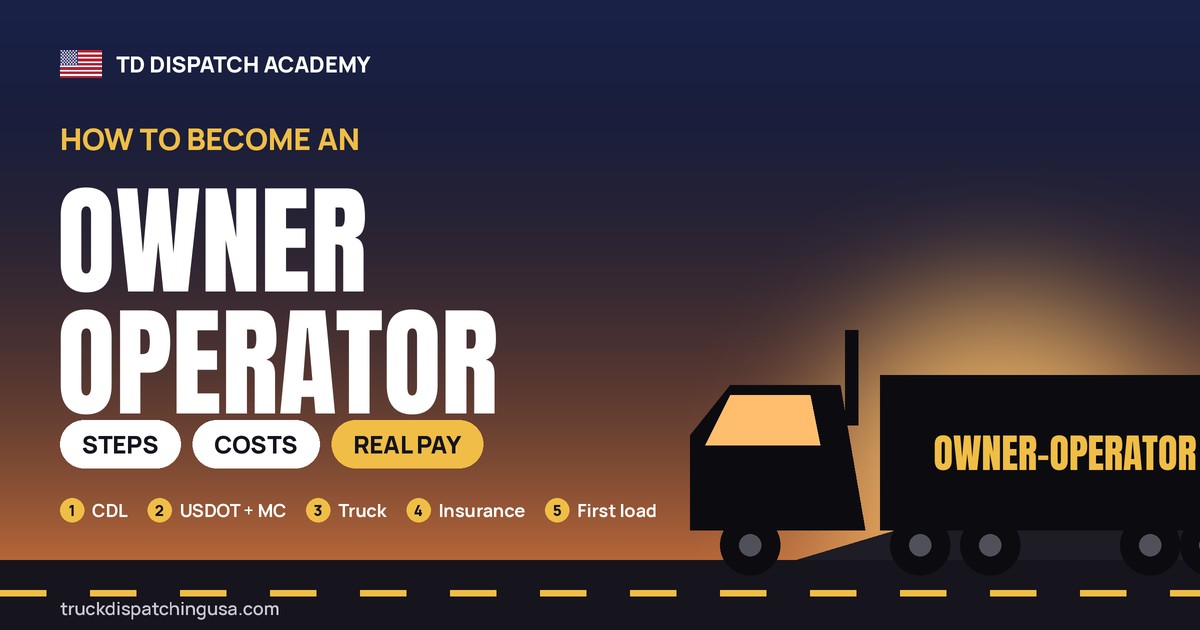
If you want to know how to become an owner operator truck driver, start with one honest fact: owning the truck is the easy part. Running it as a profitable business is what decides whether you last. An owner operator is a truck driver who owns or leases their own truck and runs it as a business, either under their own operating authority or leased on to a motor carrier.
This guide covers both paths step by step, what it costs to get started, what owner operators really earn, and how to tell whether the move makes sense for you right now.
What Is an Owner Operator?
An owner operator is a self-employed truck driver who owns or leases the truck they drive and earns money by hauling freight. Instead of earning a wage, you earn revenue per load or per mile and pay every business expense yourself: fuel, insurance, maintenance, truck payments, permits and taxes.
There are two ways to run as an owner operator:
- Leased on to a carrier: you drive your own truck under another company's operating authority. The carrier supplies the authority, usually the freight, and often the primary insurance, and keeps a percentage of each load.
- Under your own authority: you get your own USDOT and MC numbers from the FMCSA, find your own freight through load boards, brokers or a dispatcher, and carry all the compliance and insurance yourself.
How to Become an Owner Operator, Step by Step
Here's how to become an owner operator in the order most drivers follow. Steps 1 to 4 apply to everyone. Steps 5 to 7 apply if you choose your own authority.
Step 1: Get Your CDL and Real Experience
You need a Class A commercial driver's license, and you must be at least 21 to drive across state lines. Most successful owner-operators drive for a company for a year or two first. That time teaches you lanes, loading, hours-of-service rules and how freight really moves. It also matters for insurance, because many insurers charge much more, or decline, drivers with little experience.
Step 2: Decide: Lease On or Own Authority
This is the biggest decision you'll make, because it sets your costs, your control, and your risk.
Leasing on is the lower-risk start. The carrier handles authority, compliance, and most freight, so you focus on driving and managing your truck costs. The trade-off is less control over loads and a share of every load going to the carrier.
Running under your own authority gives you full control and the whole rate on each load, but you also carry all the insurance, compliance, and the job of finding freight. Our guide to own authority vs leasing on compares the two in detail.
Step 3: Write a Simple Business Plan
An owner-operator business plan doesn't need to be long. It needs real numbers: your expected monthly miles, your fixed costs, your cost per mile, the rate per mile you need to make a profit, and how many months of expenses you have saved. If you can't fill in those numbers, you're not ready yet.
Step 4: Set Up the Business and Get a Truck
Form a business entity, usually an LLC, get an EIN from the IRS, open a separate business bank account, and set up simple bookkeeping from day one. Then buy, finance or lease a truck. Check the maintenance history, get an independent inspection, and make sure the monthly payment fits inside your plan, not the other way around.
Step 5: Get Your Own Operating Authority
If you're running under your own authority, you apply to the FMCSA for a USDOT number and motor carrier operating authority, which costs $300. You then file a BOC-3 to name process agents, and your insurer files proof of insurance with the FMCSA. Your authority only becomes active once those filings are in place. Our article on MC authority setup explains the process and why brokers sometimes turn down brand-new authorities.
Step 6: Complete Registrations and Compliance
Running your own authority comes with a list of registrations and programs:
- Insurance: at least $750,000 in auto liability for general freight, plus the cargo and physical damage cover that brokers and lenders require.
- UCR: annual Unified Carrier Registration.
- IRP and IFTA: apportioned plates and fuel tax reporting if you run in more than one state.
- Form 2290: the federal heavy vehicle use tax for trucks with a taxable gross weight of 55,000 pounds or more, up to $550 a year.
- Drug and alcohol testing: join a testing consortium for random testing and register with the FMCSA Drug and Alcohol Clearinghouse.
- ELD: an electronic logging device to record hours of service.
The FMCSA also runs a new entrant program. Your first safety audit happens within 12 months of starting operations, and you're monitored for 18 months, so keep your files in order from day one.
Step 7: Find Freight
With your own authority, you get loads from load boards such as DAT and Truckstop, directly from brokers, from direct shippers, or through a dispatcher. Every load should be checked against your cost per mile before you accept it.
How Much Does It Cost to Become an Owner-Operator?
Your startup cost depends on whether you buy or lease a truck, and whether you run your own authority. The highest costs are the truck down payment, insurance, registrations and working capital to cover expenses before your first payments arrive.
Insurance is where the two paths differ most. Truck Writers' 2026 rate data puts insurance for a leased-on driver at about $3,000 to $5,000 a year, because the carrier covers primary liability and cargo. A new authority in its first year typically pays about $15,000 to $25,000 a year, dropping to around $9,000 to $14,000 once the authority is three years or older.
For a full line-by-line breakdown, including the working capital most new drivers forget, read our guide to owner operator startup costs.
How Much Do Owner Operators Really Make?
When people search for an owner-operator salary, they're usually comparing two very different numbers: gross revenue and what's left after expenses. ATBS, an accounting firm that works with thousands of owner-operators, reported an average income of $71,800 in 2025, on roughly 95,000 miles a year.
Gross revenue is much higher because it includes every dollar the truck brings in before expenses. ZipRecruiter data cited by Truckstop puts typical gross revenue between $125,000 and $340,000 a year. The gap between the two numbers is fuel, insurance, truck payments, maintenance, tolls, permits, and fees.
That's why your cost per mile matters more than any average. Here's an example with made-up numbers. If your total costs are $1.80 per mile and you run 8,000 miles a month, a $1.95-per-mile load average leaves you about $1,200 a month before taxes, while a $2.20 average leaves about $3,200. Work out your own figure with our cost per mile calculator before you commit to anything.
Is Being an Owner Operator Worth It?
Being an owner operator is worth it if you treat it as a business, know your numbers, and have enough savings to survive slow months. It's not worth it if you're mainly looking for a bigger paycheck than a company driver job without the extra responsibility.
The drivers who do well usually have a few things in common: real experience before buying a truck, a cash reserve, careful load selection, disciplined maintenance, and clean bookkeeping with money set aside for taxes. The ones who struggle often bought too much truck, underestimated insurance, or took cheap loads to keep moving.
If you're still weighing it up against staying a company driver, our article on driving for a fleet with dispatch support shows what changes on each side.
What About Lease Purchase Programs?
A lease purchase program lets a driver lease a truck from a carrier and make weekly payments toward owning it, usually while hauling that carrier's freight. It can be a way in without a large down payment.
Read every contract carefully. Check the weekly payment, who pays for repairs, the balloon payment at the end, and what happens if you leave early. In many programs, leaving early means losing the payments you've already made.
Learn to Run It Like a Business
Knowing how to become an owner-operator gets you on the road. Staying profitable takes business skills that most drivers were never taught: cost per mile, rate and load selection, controlling fuel and maintenance, bookkeeping and taxes, contracts and risk.
Our Owner-Operator Business course covers all of that across 8 lessons, with a cost-per-mile worksheet, a workbook of templates, a final exam, and a certificate. Lesson 1 is free to read.
Frequently asked questions
How long does it take to become an owner operator?
Becoming an owner operator usually takes a few weeks to a few months once you have your CDL and experience. Leasing on to a carrier can happen within weeks, while setting up your own authority, insurance and registrations often takes longer.
Do I need my own authority to be an owner operator?
You don't need your own authority to be an owner operator. Many owner operators lease on to a carrier and run under that carrier's authority, which lowers insurance costs and removes most compliance work.
How much do owner operators make a year?
Owner operators averaged about $71,800 in income in 2025, according to ATBS, on roughly 95,000 miles. Gross revenue is much higher, often $125,000 to $340,000 a year, before fuel, insurance, truck payments and other costs.
How much does owner operator insurance cost?
Owner operator insurance typically costs about $3,000 to $5,000 a year when leased on to a carrier, and about $15,000 to $25,000 a year for a new authority, according to Truck Writers' 2026 data.
Can I become an owner operator with no experience?
You can become an owner operator with no experience, but it's risky and expensive. Many insurers charge much higher premiums or decline drivers with little experience, so most owner operators drive for a company for at least a year or two first.
What is the difference between an owner operator and a company driver?
An owner operator owns or leases their truck and pays all business costs, earning revenue per load or mile. A company driver drives the company's truck and earns a wage, while the company pays the truck's costs.
Want this handled for you?
We dispatch owner-operators from 6% of gross or $300 a week, and file new authority for a flat $649 plus government fees at cost. No contracts either way.
Keep reading
Carrier Onboarding: What's in a Carrier Packet and How It Works
What carrier onboarding is, what goes in a carrier packet and why brokers ask for each document, plus the full
GuideWhat Is a CSA Score? How It’s Calculated and How to Lower It
How CSA scores work in trucking: the seven BASICs, severity and time weights, intervention thresholds, and the
BrokersHow to Become a Freight Broker: License, Bond and Real Costs
Step-by-step guide to becoming a freight broker: FMCSA broker authority, the $75,000 bond or trust, real start